
Colours of Memory
Josef Albers, Paul Cézanne and memories of home

In early 2023, I had the opportunity to visit the Josef Albers Museum Quadrat in Bottrop, Germany, and take part in a 2-day workshop with a special focus on the pedagogy of Josef Albers. A visit to the temporary exhibition Josef Albers: Huldigung an das Quadrat (Homage to the square) was part of the workshop.


While exploring the rooms of a beautiful, soft-lit museum building, catching glimpses of the sleepy February nature of the surrounding Stadtgarten Park through the large windows, I slowly passed through the white rooms full of Albers’ paintings - a “yellow room,” full of yellow squares, a very charged “red room,” and others. There was only an hour, and, of course, it was not enough to take it all in. I stood in front of the paintings, admiring the depth of colour on some and the lightness and low opacity on others, the interaction of a specific colour of a square within a colour of another square, creating a sort of halo effect, bringing another colour to life that is not there, and yet we see it.
So many combinations, so many possibilities. It is no wonder that Albers created more than two thousand Homages to the square and often expressed that a million years would not be enough to explore all the possible combinations and discover all that is to be learned about colour. I couldn’t agree more.
His Homage to the Square oeuvre could easily be called Homage to Colour since it doesn’t have as much to do with the square as it has all to do with colour. Colour is present fully with its raw materiality that transcends boundaries, never to be confined between the lines, but instead existing in a constant, often mysterious interplay with its neighbour, thus creating new fields and spaces of colour, sometimes pulling you in, sometimes keeping you out, even letting light emerge from the canvas. There is something deeply meditative and poetic in the squares of Josef Albers.
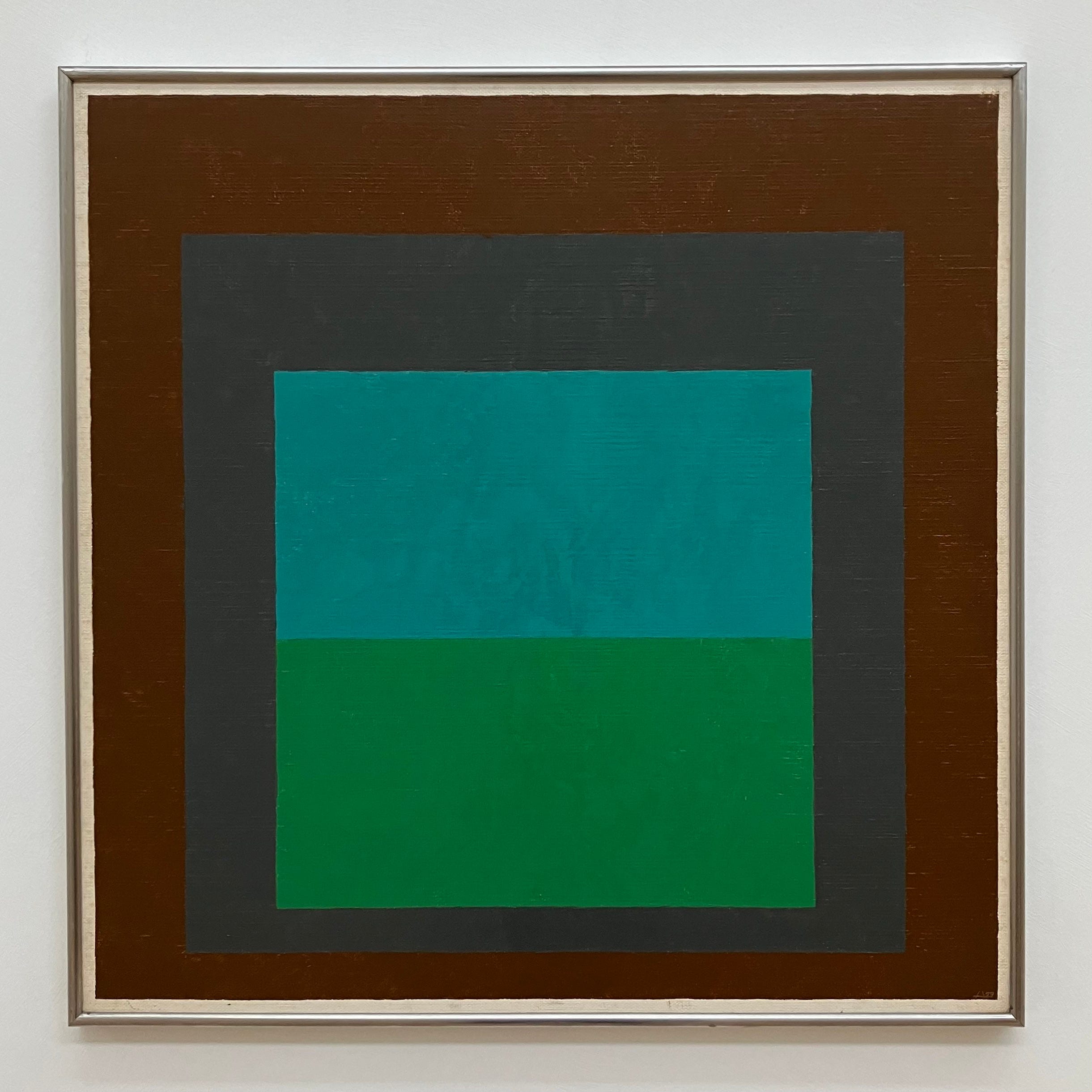
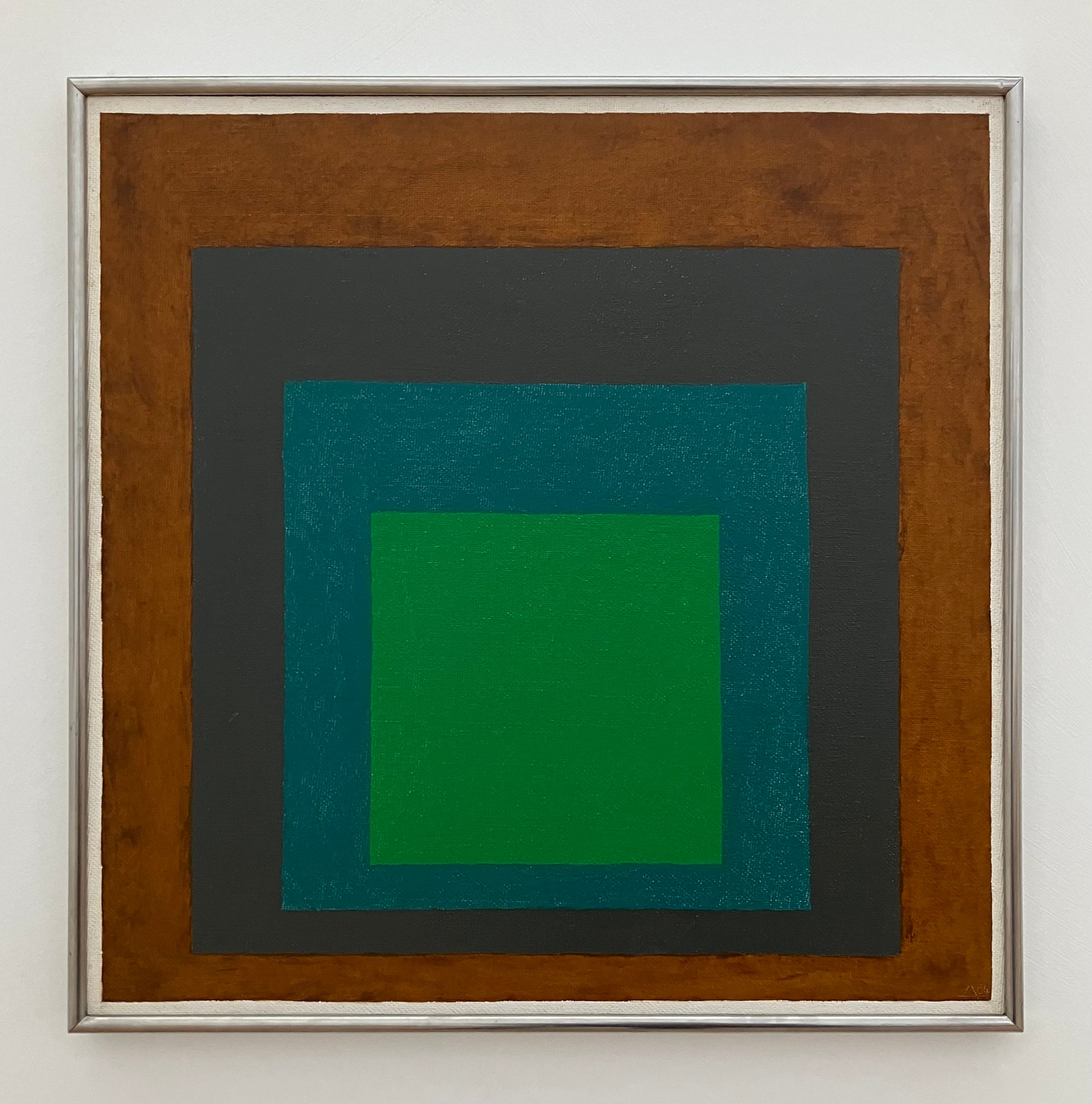
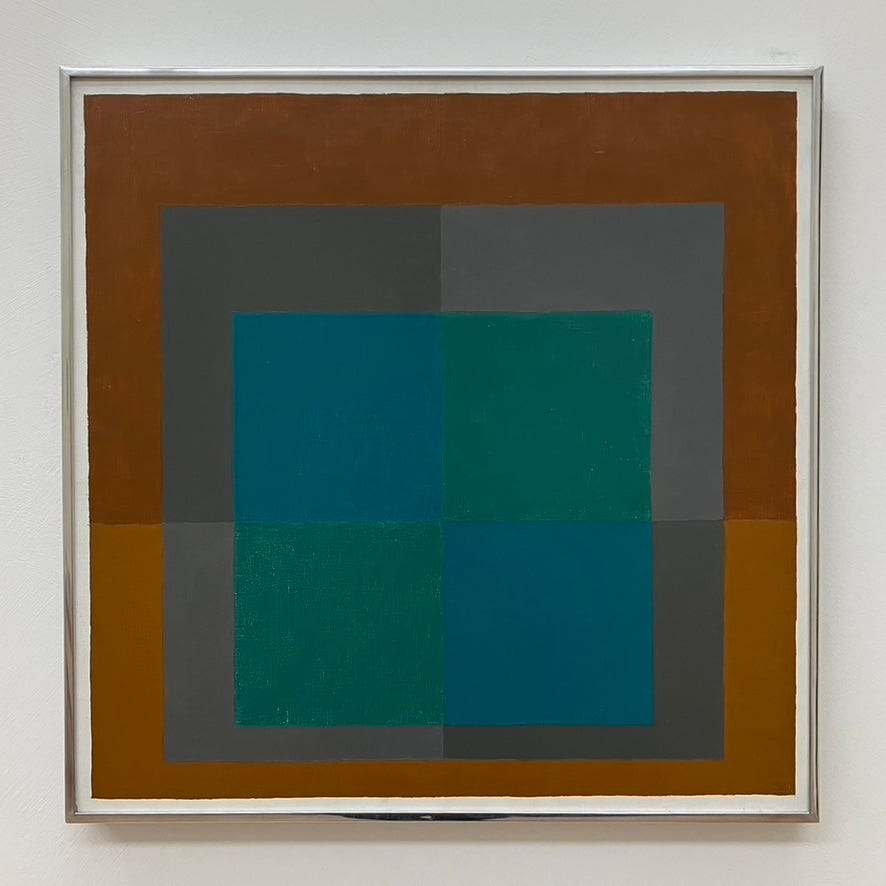
I was, of course, running out of time; there were only 10 minutes left to return to the workshop room. I quickly passed by the work of Albers’s students and barely glanced at their beautiful examples of material studies and the studies of the interaction of colour. I passed Ed Reinhard’s squares and hurried on when, suddenly, 4 canvases stopped me in my tracks and greeted me as old friends. Overwhelmed by the sudden feeling of home, or better said, the memory of home, I looked at them in surprise. It was my Madeleine moment. I did not recall seeing those 4 paintings ever before, although I might have, somewhere, long ago. It was not the composition but the colours that stood out to me. Those were the squares from the 1950s and early 1960s, which strikingly reminded me of Cézanne.
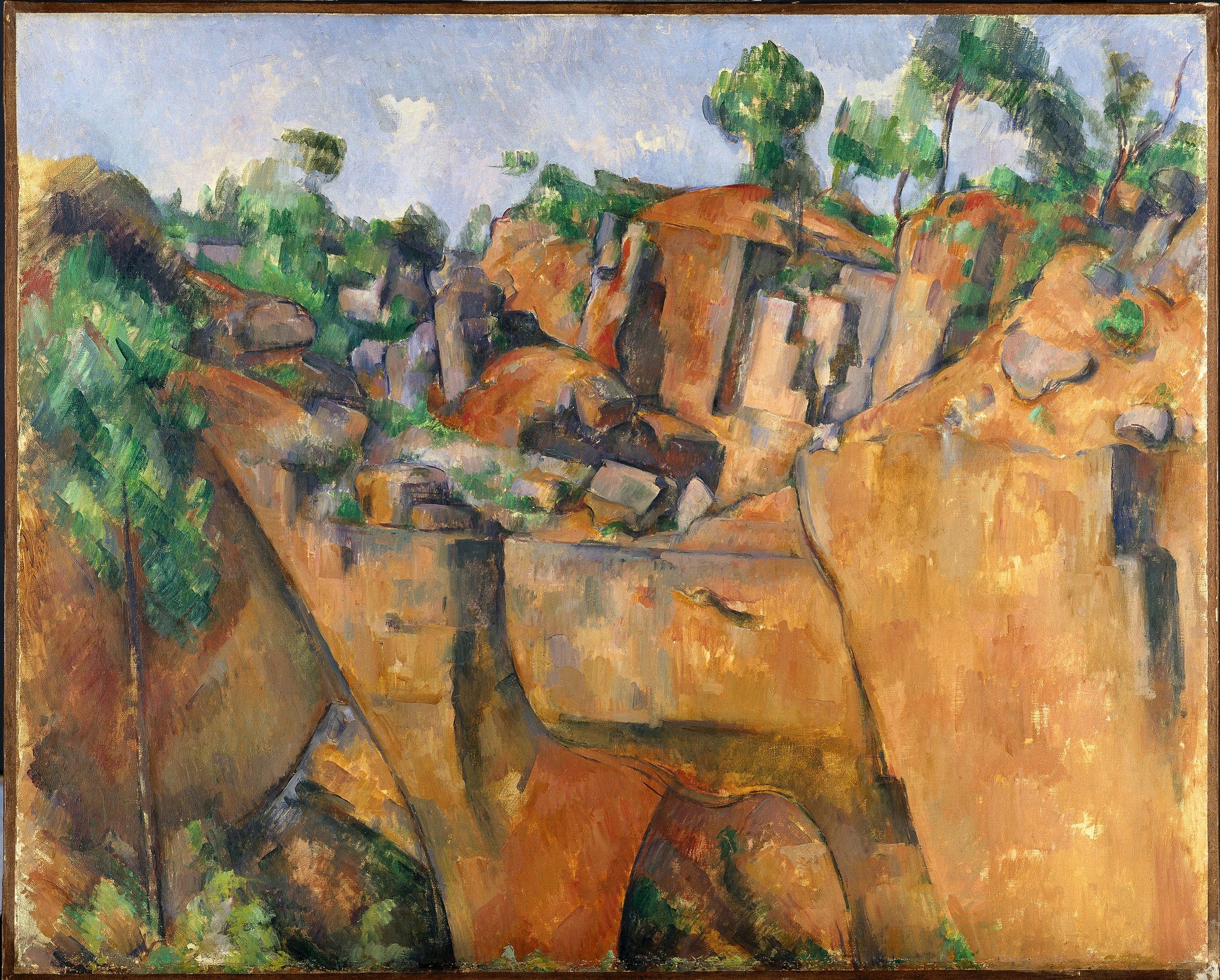
Albers often spoke of his admiration for the work of Paul Cézanne, especially the Bibémus Quarry (La Carrière de Bibémus, 1895). He probably saw the painting at the Museum Folkwang in Hagen (today housed in Essen), which acquired it in 1907.
Albers, then a school teacher in Bottrop, would visit the newly founded museum and observe that specific painting. It must have left a lasting impression on him.
Later, he would often refer to Cézanne’s use of colour and composition of loose colour-blocked patches (les taches) - creating fields of colour and blurring the boundaries - as the perfect example of colour interplay.
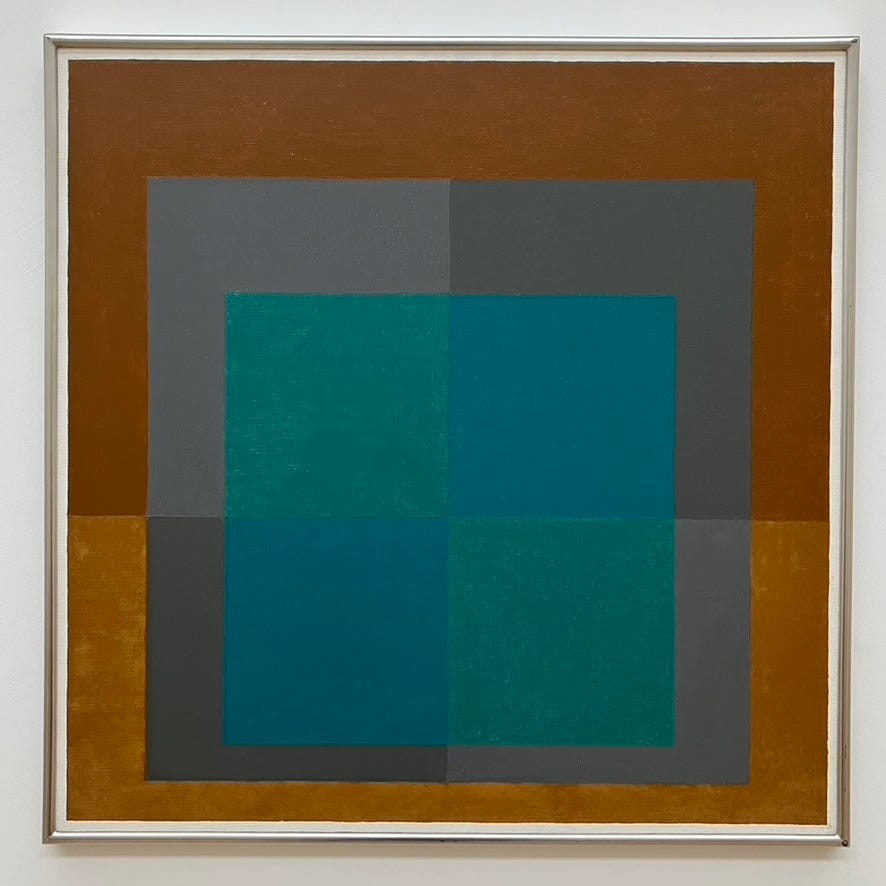
In the 1935 painting Evening (an improvisation), one of the first he created in the United States, Albers did exactly that, exploring the boundaries between individual areas of colour.

And there I was, with those beautiful compositions of browns and greens, bringing me into another world, another time. And it was not only the browns, ochres and greens that I saw - I saw orange as well, the orange that was not painted on any of those 4 canvases but was nevertheless imprinted somewhere deep in my memory, associated with those colours I was looking at, in a very personal way.
My mother, who was an art historian, loved Cézanne and Gauguin. My earliest childhood memories involve seeing their paintings every day, through my mother’s art books and two high-quality Italian reproductions that hung in my house.
My mother often told me stories about their artworks and their lives, and the colours of their art intertwined with the memories of my childhood.
In my home, there were the dark brown colours of the modernist furniture, with accents of green and orange. I remember a dark green, wavy vase that fascinated me as a small child and stark orange, matte-surfaced lamps that one could pull down to eye level. While the interior was quite minimal, those were the warm, embracing colours that had coloured my memories of childhood and the safety of home. Among them - the playful memories, the serene and intense moments of piano practice that would see the bright, sunny interior embrace the soft shadows of the evening, resonating with the mellow tone of my Petrof piano, many hours spent with the Russian classics and many moments of laughter, a lot of laughter.
How could that all be encompassed in 4 Albers’s paintings, in the interplay of those colours, the visible and invisible ones? It all caught me by surprise and made me think of the colours hidden in memories, those lived and those conceived, intertwined gently with each other, by many associations built along the way.
Colour makes our memories come alive.
“When you really understand that each colour is changed by a changed environment, you eventually find that you have learned about life as well as about colour.”
-Josef Albers (from Josef Albers: The American Years, Washington 1965, p. 28).
Michel Pastoureau writes in his book The Colours of Our Memories about this very topic, sharing his childhood memories and colour associations. He explores colour as a social, emotional and memory-driven phenomenon. Who is to judge the alternative reality of colour memories?
"The historian knows well that the past is not only what was, it is also what memory has made of it. As for the imagination, it is in no way opposed to reality: it is neither its contrary nor its adversary, but constitutes a reality itself - a different reality, fertile, melancholy, an accomplice to all our memories."
- Michel Pastoureau, The Colours of Our Memories ( Chapter 1, The Arts and Letters)
For those interested in the relationship of colour and memory, Ingrid Calvo Ivanovic explores the intricate relationship between colour, emotion, and memory in Mnemosphere, an interdisciplinary research project investigating how the memory of places can be designed and communicated through experiential spaces capable of stimulating emotions - The Colours of Individual and Collective Memory: Mnemosphere, a Visual Atlas of Memory, Emotions and Atmosphere of Places.
Mnemosphere: Designing a Neologism between Memories, Emotions and Atmospheres is a collection of essays written by authors from different disciplinary and professional backgrounds, offering various points of view on Atmosphere.
Colour Memories is an online exhibition presenting the personal stories and connections to colour by architects, designers, artists, and educators.
Colours faded by sunlight, whether in reality or on the surface of the photographic prints depicting my childhood, are to me, seeped in nostalgia.
No colour captures this more than the faded orange that defines my earliest memories.
It was the colour of my parents’ Opel Kadett, parked outside the first home that I can remember.- Jonathan Hagos, architect - Colours of Memories online exhibition
What colours are your memories made of?
Tomorrow I will be returning to the Josef Albers Museum Quadrat in Bottrop for the workshop Interaction of Colour in Space (June 27-28, 2026).
The idea of this workshop was born during that first visit to the Museum in 2023. It has been in preparation for more than 2 years, and is a true team effort, spanning continents. Organised by two colour associations (of Belgium and of Germany), with the support of the Josef and Anni Albers Foundation from the US and the Josef Albers Museum Quadrat in Germany, with the lecturers from Spain, Switzerland, and Germany. Colour unites.
It has been a pleasure to organise this workshop, and I am looking forward to making new connections, new insights and new colourful memories.
The workshop registration has closed, but if any of you would like to jump in and join at the last minute, send me a message; we still have one place left. And there is air-con at the museum :)